Have you thought about doing a project recently? It could be cleaning your drawers, making a grocery list or even that project at work that you are a part of or you are managing.
Projects are everywhere (at home, at work etc) and they come in all sizes (small, medium, large). When studying and starting my career, I always came across one way of doing projects; the waterfall method. Write down all the small steps and then think about the sequential manner in which they can be organised. It was easy to learn but terribly ineffective. Why?

Firstly, because tasks don’t need to be done sequentially, they can be done simultaneously. Secondly, circumstances also change, therefore, your plan may need to adapt. Over the years, my approach to project management became more agile as I undertook a McKinsey Forward Programme, obtained a PMI-Agile Certification and joined a really cool civic-tech organisation where we created technology geared towards creating better urban spaces for people.
My thought process changed from thinking about sequential and up-front planning to doing tasks simultaneously and adaptive planning that enabled me and my teams to change course, if required. When working on tech products with other teams, however, I realised that the same, outdated waterfall method was still used in other spaces. Software was “procured” and bought from vendors based on an initial needs list without thinking about adaptive needs or being “locked” to a particular software vendor.
Lets take an example in our lives. Imagine, you are a student and want to open a bank account. You are a student so you find the cheapest account that is available and subscribe to that. When you graduate and get a job, your needs have now changed. You need a credit account, perhaps more perks and rewards, so you started shopping for a new product that would meet your “new” needs. If your current bank doesn’t have something that meets your needs, you can leave them easily and join another bank. Simple and easy because we are talking about a change in 1 person’s life.
However, for big institutions like our cities, things aren’t that easy. Change is harder because it impacts many people’s work and impact on services need to be thought about. There are various considerations as well like safety, security, privacy as you deal with the data of millions of people at some point. Our city institutions bedrock of software procurement though has been watefall-y and procurement-focused. Therefore, even when vendors aren’t able to meet their needs, city institutions continue using them because they have always done it that way and are already in long contracts with the vendor. Stay with what you know right? There is an excellent working paper written by Boots et al., where they unpack IT procurement policy reforms needed in Canada to prevent expensive debacles that cost taxpayers large sums of money without solving real user needs.
Things are changing though as our cities adapt to learning about a new way of thinking. Recently, I came across a fantastic article by Jennifer Pahlka. Jennifer astutely shows how software needs evolve and rather than think about spending to procure in one chunk, we need to create systems where we can build software overtime. In a nutshell, “software is never done”. With the product and agile thinking, our institutions can go into the new age of using their data with the best tools that work for their teams. Just like cities, software only works when it is works for its users.
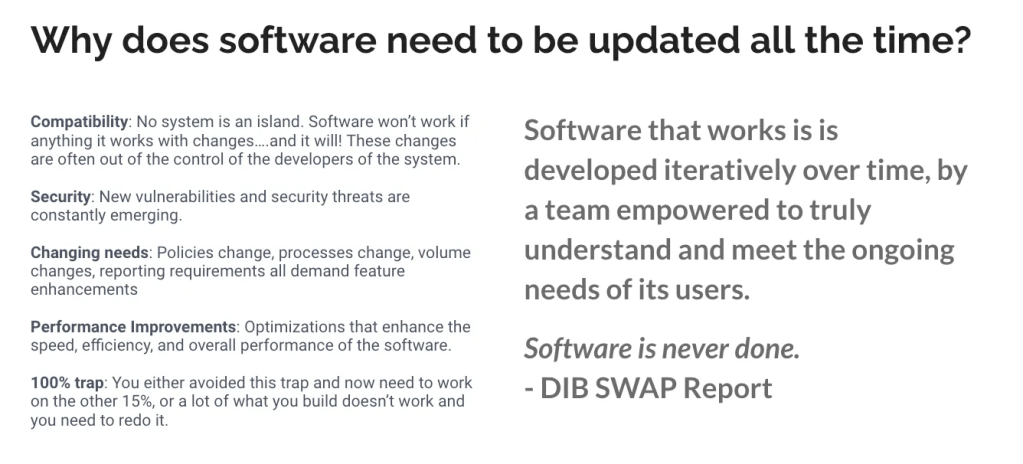
Source: Jennifer Pahlka, https://www.eatingpolicy.com/p/project-vs-product-funding


 Aliasgher Janmohammed