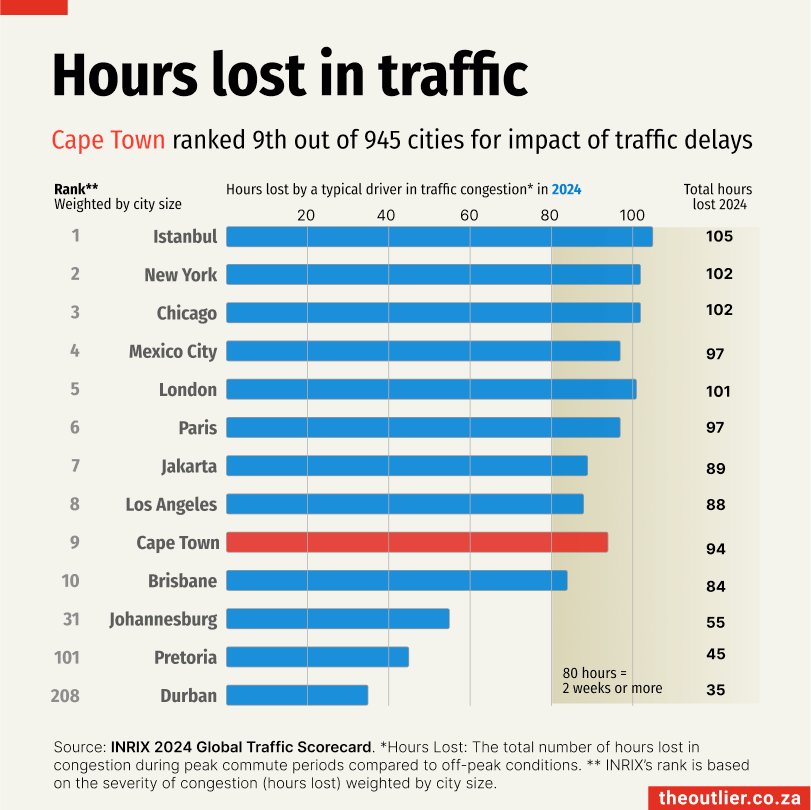
By now, I’m sure every Capetonian has seen those stats showing Cape Town ranking as the 9th most congested city in the world. Pretty wild, right? Look deeply, and it actually shows urban mobility with most South African cities, and honestly, across many African cities too.
Source: The Outlier, https://theoutlier.co.za/charts/chart/90052
Here’s the funny thing – South African cities were actually built with cars in mind, but that’s exactly what’s biting us in the back now. The whole setup isn’t working anymore, and we’re all stuck in traffic because of it. There are some solutions in the works, for example, the Transit Oriented Development that’s will create a second CBD in Bellville. The idea is to spread out all the origins and destinations so we don’t have everyone and their dog trying to drive to the same place every morning.
When I saw these traffic rankings, I jumped onto a bunch of Reddit threads to see what people were saying. I was honestly expecting tons of comments calling for more lanes (you know, the usual “just build more roads” argument that succumbs to induced traffic demand). But to my surprise, most people were pointing out the need for a decent public transport system that connects different parts of the city. Music to a transport planners ears.
This reminds me of something interesting I learned during my masters – this whole idea of “captive” versus “choice” transport users. Basically, captive users are stuck with whatever transport they can afford, while choice users can hop between different options whenever they want. And this is where I think we’re really dropping the ball in South Africa.
Take my own story – I used public transport all through university because I had to, but the minute I could afford a car, I jumped ship. Why? Because suddenly everything became so much more accessible, even with traffic. I’ve heard the same story from pretty much all my friends and colleagues – they used public transport because they had to, not because they wanted to. As soon as they landed jobs that could pay for a car, they were out.
That’s the real problem right there – our public transport isn’t winning people over with great service, it’s just the only option for many people until they can afford something else. What we really need is public transport that’s so good people actually want to use it, even when they could just drive instead. Of course, magically creating better public transport won’t make it “sellable”. Land use, which plays a hand in hand role with transport, needs to bring people’s destinations closer to their origins. I will be exploring some of this thinking and theories in my next few posts, particularly the infamous utility theory that assumes that every person is always trying to find the shortest distance between two points (spoiler alert, its not that simple).


 Aliasgher Janmohammed