This week, I’ve been researching the silo challenge that often arises in large institutions and organizations like government. The challenge of siloed work is well-documented in government—in fact, the government itself has raised this risk multiple times on various platforms (Google search “silo government structure”). Silos are essentially when two or more departments don’t coordinate to solve a challenge, thus using more resources, having multiple similar projects and not solving the real issue. But silos aren’t just a government problem; they exist across different spheres. From my own experience and conversations with colleagues in this space, I’ve seen silos in health, education, transport, social services, and many other sectors.
This challenge also extends beyond public institutions. A colleague—an expert facilitator—once told me about his work with a large private organization to coordinate its marketing efforts. When he entered the room, he quickly realized that different units weren’t speaking to each other. Digging deeper, he found that across these units, there were 28 separate marketing initiatives for the same product that didn’t align. 28! (Yikes.)
At the core of this issue is how government departments are structured. Each department is responsible for a specific set of services related to its function. For example, a city’s water department ensures that residents have access to water efficiently and effectively. Each department has a head or manager with key performance indicators (KPIs) to meet, which are reported up the chain to their manager, president, or line director.
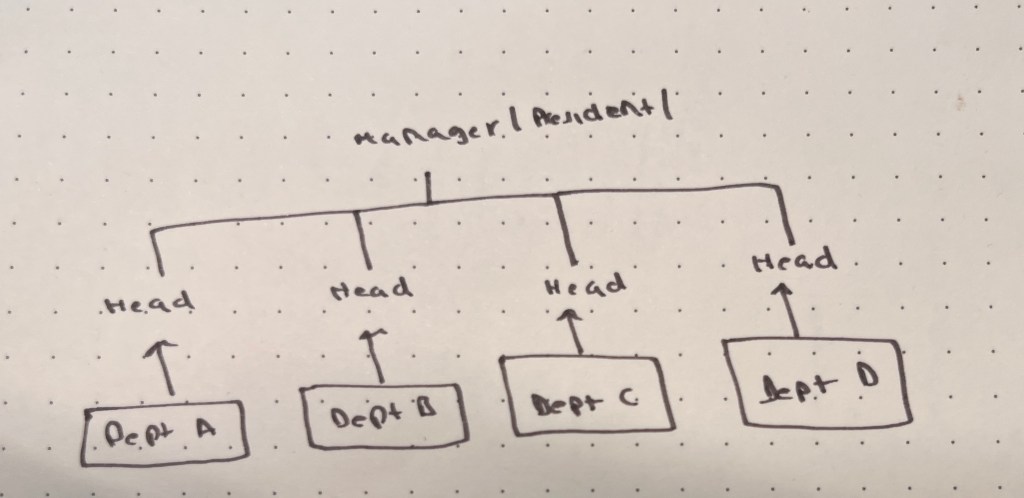
But what happens when horizontal collaboration is required in this vertical structure? Let’s say the housing department needs to deliver services to an informal settlement. It must coordinate with water, electricity, and other service departments to ensure effective delivery. However, if each department has separate KPIs or if their systems don’t “speak” to each other, critical services can be delayed, inadequate, or even fail entirely. A similar challenge arises with cross-functional enablers like data. When departments operate in silos, data remains “locked” within them. I often hear departments express concerns about what would happen if their incomplete data were shared and used for analysis. But this is really a Pandora’s box—one could argue that departments don’t actually own any data; they are merely custodians of it for the city and its residents.
Going back to the original problem statement: any “wicked” problem requiring cross-departmental work becomes exponentially harder if each department functions as a monolith, delivering on its own goals without considering the nuanced, interdependent services that can prevent catastrophic failures in service delivery.
In my early research, I’ve identified four ways departments attempt to collaborate when horizontal structures are missing:
- Shared missions, goals, or KPIs that align departments to work together in service delivery.
- Departmental champions—individuals who take it upon themselves to collaborate across departments, either formally or informally.
- Ad hoc collaboration—interactions that happen as needed but lack a structured directive.
- A coordinating department or role—a dedicated entity responsible for unlocking collaboration across departments in specific areas such as data, digital, technology, or communications.
There are excellent examples of these approaches in practice, with significant results. The COVID-19 response was one such example. During my work with the Western Cape Government, I saw various departments come together to provide coordinated services toward the shared goal of reducing the spread of the virus.
A more radical approach would be to eliminate vertical structures entirely and restructure government around shared values and missions. Many residents already perceive government as a single entity. If they see a pothole, they don’t distinguish between local and national government—they see it as the President’s problem. This perception played out during last year’s power crisis in South Africa. Electricity services required coordination between two national departments, but due to various challenges, they failed to solve the problem. The President ultimately created the Electricity Department within his own sphere to provide centralized coordination for this crucial service.
That said, my view is that silos are an inherent part of any system. Eliminating a vertical structure wouldn’t eliminate silos; they would simply re-emerge at a smaller scale.
I’ll be reading more about this topic in the coming weeks, so if you have any resources to share, please drop them in the comments!
An interesting paper on a Hong Kong case study: https://link.springer.com/article/10.1007/s43508-021-00004-z


 Aliasgher Janmohammed