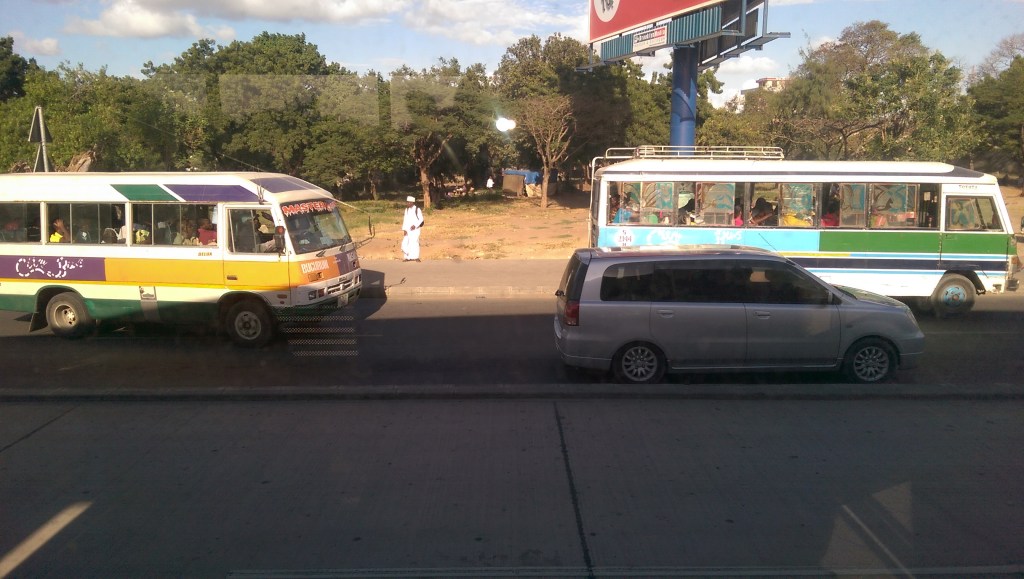
Visit any African city, and you will find people travelling in overloaded, cramped public transportation systems that, to the naked eye, seem chaotic at the least. Unintended stops, traffic laws violated, and drivers that seem to only know where the accelerator is, these forms of transport have been called in literature as paratransit or “informal” modes of transport. I don’t like the word informal, though, as it is often used for exclusionary things. Colloquially, they go by many names. Daladalas in Tanzania, Matatus (“mischief maker”) in Kenya, Molue (“going to suffer”) in Nigeria or simply taxi in South Africa.
Growing up, I often used paratransit to get to school. I heard all the negative stories about it, which studies and official records show are quite true. However, for me, those stories seemed otherworldly. Why? Because it got the job done for me. In fact, it gets the job done for many people. Taxis in South Africa, and their other forms of transport in other African countries, are used by the lion’s share of public transport users at 72.4%. And there are 3 reasons for that. Reliability – They get the job done, in that if you have to go from point A to point B, you won’t find a more reliable form of public transport system. Availability – They won’t cancel on you (well, most of the time), and there are often plenty of options that are running simultaneously. Affordability- they give you the best bang for buck, aside from railway systems perhaps, but when you consider the other two factors, taxis get the nod. And while taxi or paratransit users know and have heard about all the challenges, what they truly care about is getting to their jobs, and taxis make that happen. In Cape Town, for example, the majority of workers have to travel into the CBD to access work – a common symptom of spatial apartheid planning – and taxis help their users to access those jobs.
Public transport, in itself, is misunderstood because of its different components. Unlike car usage, a public transport user doesn’t just have to walk a few metres to their car and drive away to their destination. PT users have to walk to their nearest station, wait at the station, drive in the vehicle, and finally, walk from the station to where they ultimately aim to go. And the metrics are minute. Once, I had a colleague who saw a PT user cross the highway rather than use the pedestrian bridge. In a sudden moment of inquisitiveness, he approached her and asked why she would do that when the bridge was mere feet away. Surely it was safer, he argued. She told him that if she took the taxi where the bridge merged, she would have to pay R1 more, and that difference was crucial for her. Households spend large parts of their income on transport, and taxis assist their users in tackling that issue.
In a former life, I worked in the road safety sector, and once a colleague shared that showing graphic images or videos of people dying from crashes often had the opposite effect. Rather than people changing their behaviours, most disassociated from the person in the video, thinking they won’t be in that scenario. Taxi users also know about the safety issues that it has; they are in them when they break the rules. But, and this is an important but, the choices are limited, and food on the table takes precedence over personal safety for many. Household incomes are predicted to shrink, and the affordability component of public transport (PT) users will be even more important.
Public transport is the lifeline of an effective city. They are cost-effective and have a positive effect on various components like reduced CO2 emissions, traffic and many more sustainable development goals. While a car spends the majority of its time being parked, public transport churns on, moving people to every house. They also have a huge economic component, enabling millions to access essential services that positively support society at large. Taxis, as part of these systems, are also part of their future. In South Africa, cities have prioritised the popular transit-oriented policy (TOD). The idea is simple: enable population growth and density around transit stops so that people can access them easily, in turn using them more often. The backbone, often called the trunk, of the TOD is often a mass transit system such as a rapid bus system with its own dedicated lanes for faster speeds and/or railway tracks. Then there are feeder systems that aim to bring users to the main trunk stops for easier accessibility. The idea often touted in the policy spaces is that taxis become feeder services in the TOD network. Cycling can also be a feeder, especially for short distances.

The idea seems simple to explain, but very difficult to implement since taxis are privately owned rather than subsidised by the government. As any business owner will ask you, what do they gain from being a part of this structure? My colleague, Pieter Onderwater, a public transport specialist, shared some great ideas inspired by his Bongani Kupe. He said that what if owners moved away from owning a specific number of taxis to becoming part of a shareholding company that owned a fleet of taxis that offered feeder services. In the current model, owners of taxis take on massive liability when they rent their vehicle to a driver. The driver has to bring back a certain amount of money to the owner every week, and the rest is the driver’s take-home pay. But other than the money, the owner is at risk on many fronts. If something happens to the vehicle, the owner loses an asset with no returns. Crime and gang-related activities mean that the owner also has to pay a certain amount for protection services. But the formalisation of taxis under one or several companies offers an alternative towards a more sustainable and formalised system. Taxi stations can also become an important real estate investment. As Pieter suggests, these spaces can be rented to potential business owners and become a space for trades and investment.
The options exist, and many of these policies are already being considered in various spaces. A general shift is required, though, from thinking about paratransits as part of the problem rather than a potential solution to our wicked transport and urban challenges.


 Aliasgher Janmohammed